




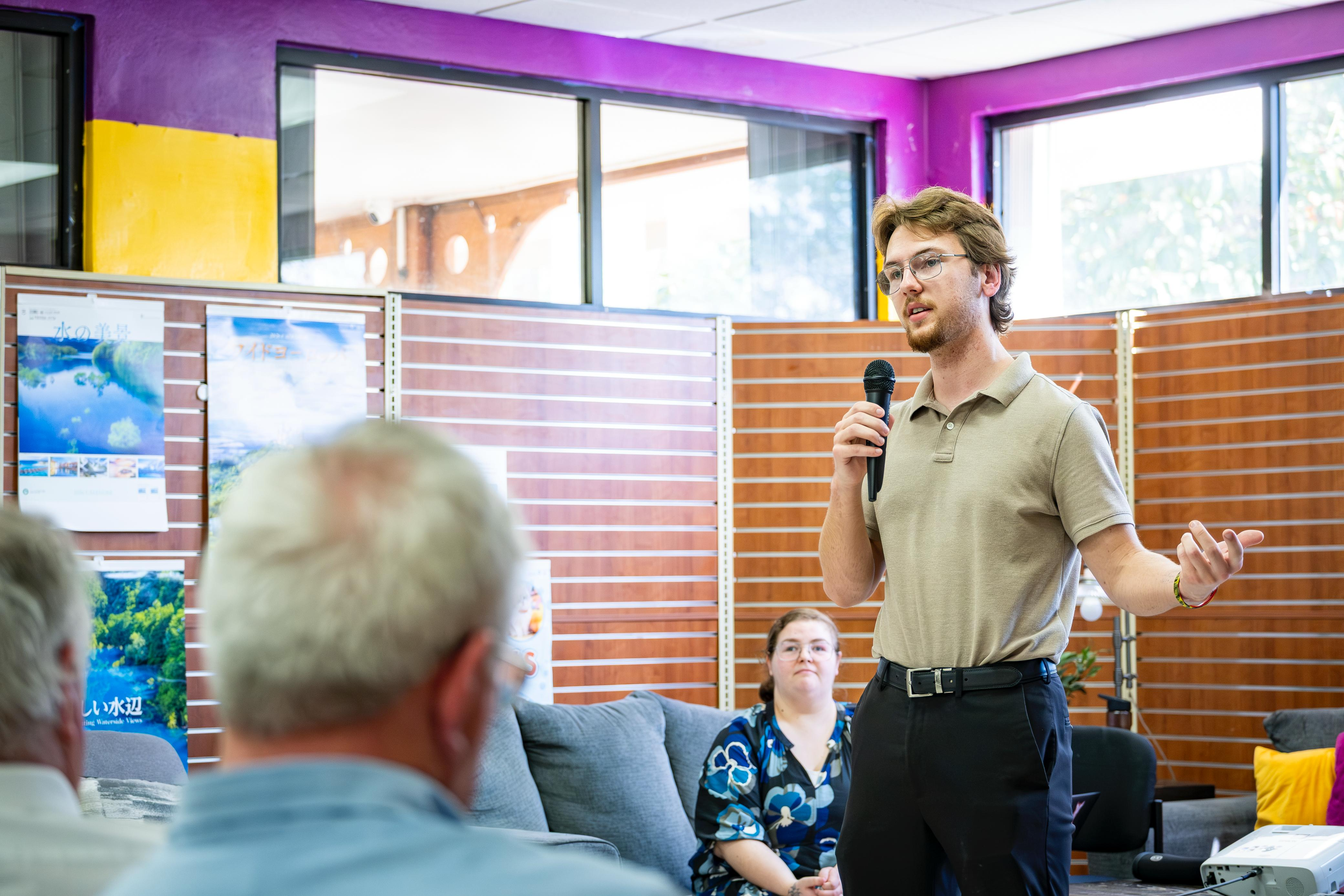
Ball State University student Michael E. Moore grew up just outside of Indianapolis. At Southport High School, he played multiple sports and was president of the school’s chapter of DECA, a nationwide organization for young leaders and entrepreneurs. After choosing Ball State for its small class sizes and opportunity to better know his professors, Moore discovered the Institute for the Study of Political Economy (ISPE), which examines the characteristics of good public and private governance. We spoke to Moore about his experience with ISPE and how programs like these help students build the critical thinking skills they will need to thrive amid AI and other technological disruptions, and economic upheaval. (Note: this discussion was edited for length and clarity.)
CKF: How did you hear about ISPE, and what drew you to it?
Moore: I discovered ISPE during the first semester of my freshman year when I was in a class with Professor Todd Nesbit. I regularly went to his office hours, and we didn’t just talk about classwork or the next exam. We talked about ideas, books. He told me about ISPE. He invited me to a talk by Dr. Burt Folsom and a discussion about his book, Myth of the Robber Barons, which analyzes political entrepreneurship versus market entrepreneurship. At that event, it was clear that ISPE’s mission was to teach students how to think, not what to think — and I just think that’s so important.
CKF: Practically, what does the program entail?
Moore: Well, ISPE brings speakers like Dr. Folsom to campus, there are reading groups, opportunities to travel, and chances to do research through the Menard Research Fellows program, which I am part of. We also have this student lounge area where there are all kinds of books, and we can gather to talk about what we’re reading or work out problems together.
It’s great because not everyone in ISPE is an economics major. So, I get to share ideas with math majors, philosophy majors, marketing majors. And we don’t all have the same opinions, so by just sitting in the lounge and talking we can work out those conflicts or evolve our ideas. The lounge is where you see that ISPE provides a haven for students who don’t just want to go through the motions of learning — who don’t just want to do the minimum — and who want a good return on their tuition investment.
CKF: You clearly are not doing the bare minimum. Can you tell me about the research you’ve done as part of the Menard Scholars Program?
Moore: So, I’m currently writing a paper with Dr. Nesbit on regime legacy/regime memory and economic freedom and its impact on perceived control of corruption within a country.
CKF: Wow. Please unpack what that subject matter is!
Moore: Sure. The best example is the USSR. When it collapsed, so many people thought that introducing new rules and laws would automatically get rid of corruption. That’s not necessarily the case because there is a culture that develops under authoritarian, autocratic regimes, and people sometimes revert to those norms no matter what the law says. It’s why we need to be really careful about our foreign policy.
Another part of my research work is to help with the Founding Scholars Program, which analyzes the intellectual root of the American Revolution. With America’s 250th anniversary this year, so many people are looking back at history and the impact of that legacy. But what we really wanted to look at is, okay, what were the founders reading? What was the backbone behind the Declaration and the Constitution? What we do is archive all the founders’ bookshelves, basically, and read those books to try to determine how what the founders read applies to pursuing happiness and human flourishing in the modern sense.
I’ve also written papers on crime in Belize and marriage patterns from the 12th to 18th centuries. So, there are a lot of research opportunities within ISPE!
CKF: Going back to the student lounge, are you taking the papers you’re writing and bouncing ideas off friends in ISPE?
Moore: That absolutely happens! It’s become so fundamental to me that it’s hard to remember that not all students around the country are experiencing this kind of back and forth — they’re not being asked to wrestle with ideas they don’t always agree with. I’m an economics major, so I think of things in terms of the market. I’m only one person. No matter how smart I become, I can never trump the market. In ISPY, I have 20 or 30 students I can turn to who all have different philosophies and different perspectives. My knowledge is increased by their knowledge.
CKF: That’s quite a meaningful experience, and one that should influence how you live and work after graduation. How do you think your experience in ISPE will help you navigate an economy that some say is getting more difficult for college graduates?
Moore: There’s a lot of emphasis by college students on technical skills. I need to know Canva because I’m a marketing major. But what good does that do you if Canva is replaced in a year? I’m working on an article on the utilization of AI among different groups of students. There’s an interesting dynamic that occurs when a disinterested student uses AI. Often, they use it to cheat. Meanwhile, a student who is passionate uses AI as a complementary tool, not to supplant their own thinking. I think ISPE helps develop passionate students — students who will be better equipped to innovate and contribute no matter what technology they are asked to use.
CKF: To conclude, let’s move from the personal benefits of ISPE to the broader ones. When it comes to sustaining a functioning society, why are programs like ISPE important?
Moore: I guess I would say programs like ISPE help us preserve our freedom. Politicians are self-incentivized; they promote a certain ideology or a certain narrative that is conducive to their self-interest. As citizens, we need to monitor and constrain that self-interest. We must think critically in order to do that, and we must be able to talk with one another about hard topics to do that. When we lose that ability, we’re at risk to authoritarian regimes. Also, going back to my previous answers, I’d just say programs like ISPE that foster different perspectives help drive innovation and a type of entrepreneurial mindset that is necessary for economic prosperity.
As adoption of AI and other technologies accelerates, programs like ISPE teach students to think critically, engage across differences, and apply ideas in new contexts. Learn about CKF’s support of programs like ISPE.