
As the United States enters its semi-quincentennial year — the 250th anniversary of the signing of the Declaration of Independence — it faces significant upheaval. Rapid technology advancement has changed how Americans think about postsecondary education, work, and career progression while political polarization seems to have deeply divided our society.
These challenges are real, but the Charles Koch Foundation (CKF) is optimistic about Americans’ ability to overcome them. It is why we invest in social entrepreneurs who identify, explore, and create solutions to overcome barriers to human flourishing. Whether our partner changemakers are working to build a better future of work for all people or to enhance pluralism and liberalism, they share with us a belief in people and a belief the principles of human progress that have helped previous generations thrive in the face disruption.
Here is how some of our partners applied those principles to build a more prosperous society in 2025.
Building a better future of work
CKF envisions a society in which businesses succeed by unlocking the potential of every person. By helping people find jobs with purpose, offering learning opportunities that provide paths for advancement, and recognizing that technology is a tool to unlock — not to replace — human ingenuity, businesses create a win-win-win. They innovate and expand while employees find fulfillment, and consumers have access to the products and services they need and desire.
Our work requires unwinding the myth that the only route to success is through the four-year college system. There are numerous pathways that can lead to a life of fulfillment and contribution — elementary, middle, and high school students just need to understand what those routes are. Partners like TGR Foundation bring these options to life and help students plot a path toward a brighter future defined by their unique passions and aptitudes. In the coming years, TGR Foundation will work with the SkillUp Coalition and Make It Movement to make it easier for young people in southern California and beyond to discover their passions and plan for their future through non-degree pathways.
Jacksonville Jaguars defensive end and 2025 NFL Man of the Year Arik Armstead is unwinding the “college or bust” myth though his Stay Hungry Career Camps, which offer local youth opportunities to engage with employers and hear about the broad array of jobs these firms offer. “We are looking for well-rounded companies that offer a lot of different jobs that could pique a student’s interest,” Armstead told CKF this year. “Whether it’s marketing, shipping and processing, or retail, we want to expose kids to all different elements that make a company successful so they can see how they would fit.”
CKF partners also are helping employers plot a path toward a future of work based on human potential.
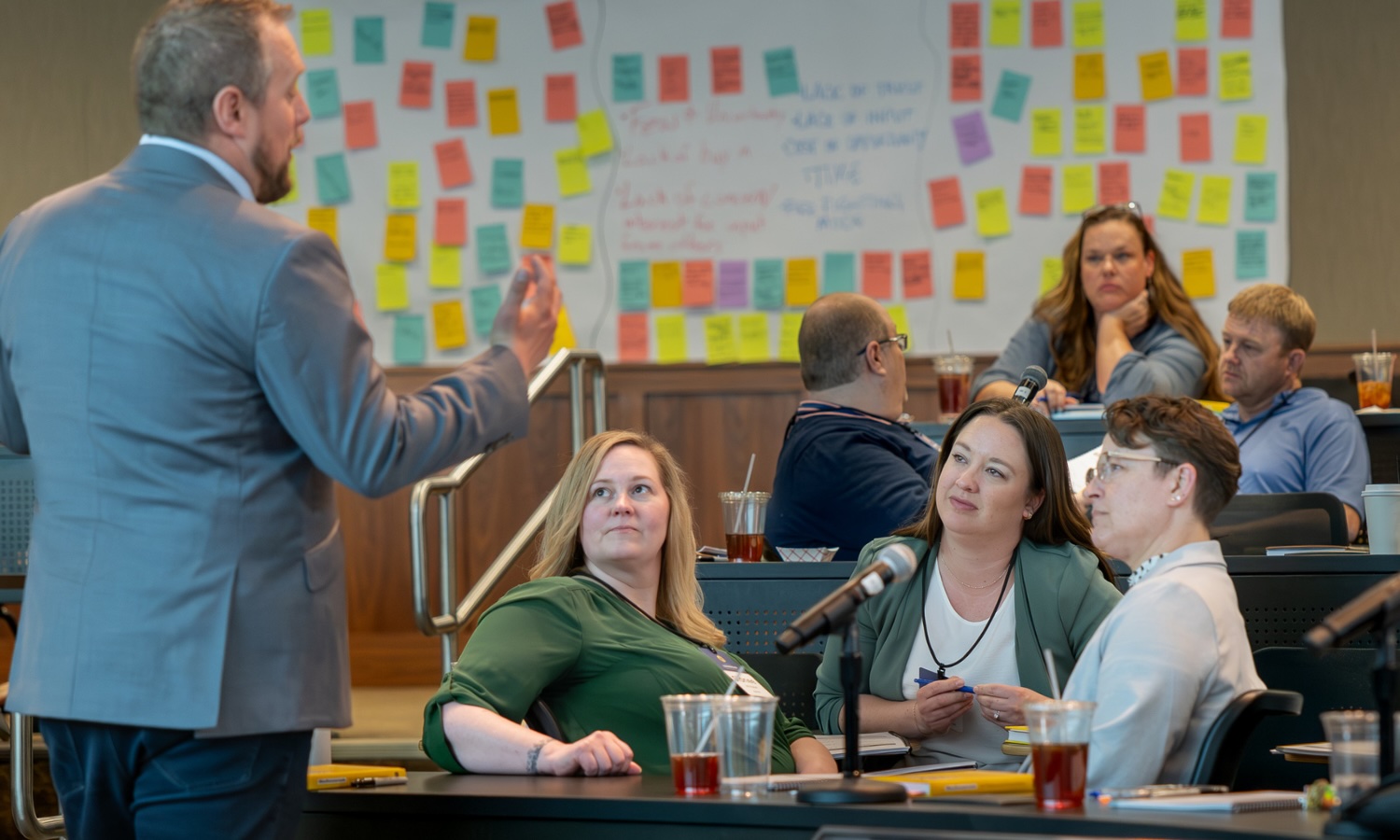
In February, the Kansas Leadership Center (KLC) launched Workforce Innovators, a team-based training program to help leaders at mid-size companies transform their thinking about workforce development. For workers at the 11 companies in the first cohort, the program has enhanced companies’ commitment to create cultures of continuous learning and skills acquisition. For businesses, it has enhanced their ability to attract, grow, and retain talent.
Also in February, the Burning Glass Institute released its Skillability Index, which provides a benchmark for skills-based hiring practices throughout the economy. Using 316 million job postings, Burning Glass examined companies based on their commitment to degree requirement removal, non-degree hiring, and advancement of non-traditional talent. It also shared several occupations that are conducive to skills-based hiring.
CKF partner SkillsFWD continues to drive adoption of Learning and Employment Records (LERs) — digital credentials that let people own and share verified skills. Since launch in 2023, grantees have issued 9.2 million learning and employment records to 192,000 learners and engaged 1,800 employers, proving LERs can scale. Projects include Alabama Talent Triad (AL), Accelerate Montana, Central Ohio Talent Network, ColoradoFWD, Indiana Achievement Wallet, and MyCareerForward Pittsburgh.
Education Design Lab is working with more than 100 community colleges across 20 states to design nearly 300 micro-pathways in industries ranging from manufacturing to behavioral healthcare. For example, in the Lone Star State, EDL and the Skillup Coalition have facilitated collaboration between employers, educators, and workforce organizations to create awareness and prepare Texans for emerging opportunities in the digital economy. The Texas Flywheel Initiative is working with local colleges, training providers, and employers to create awareness of existing programs and co-design new micro-pathways, with stackable credentials aligned with employers, talent needs, enabling more Texans to access to high-opportunity roles in data centers and related fields.
While the technology sector is full of employment opportunities, Americans are worried about artificial intelligence (AI) and its effect on the workplace. Per Scholas’ partnership with AdeptID demonstrates how AI can match workers with the types of jobs they want. More specifically, Per Scholas uses AdeptID’s matching engine to help its team review thousands of alumni resumes to find the best candidates for employer job openings. Previously, this process was time-consuming, an obstacle that diminished applicants’ ability to get noticed in a fast-paced hiring environment.
In 2025, CKF also expanded its partnership with SkillsUSA, including by supporting a national conference that brought together thousands of students, instructors, business partners, and administrators to celebrate the accomplishments of people preparing for careers in trade, technical, and skilled service occupations. Watch the excitement unfold.
Each of these programs confront this question: what conditions best facilitate human innovation, fulfillment, and advancement? A new program at Florida Atlantic University (FAU) invites future business leaders to answer that query. The Mortimer J. Adler Fellowship in Transformational Leadership, a five-day program for MBA candidates and alumni, invites business leaders to explore the moral foundations of leadership, the role of character in decision-making, and practical methods for aligning professional purpose with personal values.
Drucker Institute’s “Doing the Right Things Well Podcast” also explored key questions with companies featured in their Top 250 Best-Managed Companies collaboration with the Wall Street Journal. Five of six episodes have been released, featuring senior leaders from CBRE, EPAM, Accenture, Bank of America, and the Future Forward Institute discussing how top-performing companies are applying the principles of human potential to real-world leadership, innovation, and employee empowerment.
Enhancing liberalism and pluralism
CKF supports faculty who ask questions, exchange knowledge, advance new theories, and teach ideas and classical liberal principles that help create conditions necessary for all people to find purpose and unlock their potential. Our investments help leaders learn and apply these principles to create value for themselves and others, as well as generate ideas and talent needed to solve the United States’ biggest problems.
In 2025, CKF continued its long-standing support of the Institute for Humane Studies and the Mercatus Center. As IHS President and CEO Emily Chamlee-Wright articulated in a series of articles for CKF in 2023, with surging illiberalism at home and abroad, IHS provides the rare spaces where liberals of all stripes — left, classical, and conservative — can unite behind the principles of freedom and human flourishing.
Meanwhile, The Mercatus Center at George Mason University is the premier research center advancing classical liberal ideas and cultivating the talent to apply them. It supports entrepreneurial scholars and practitioners who turn market-oriented thinking into practical solutions that shape institutions and improve lives. Similarly, the Lyceum Program at Clemson University’s Snow Institute for the Study of Capitalism studies liberty, capitalism, the U.S. founding, and moral character in order to educate the next generation of entrepreneurs, teachers, and statespeople. West Virginia University’s Center for Free Enterprise is another CKF partner that advances teaching, research, and outreach on the free enterprise system and how it relates to increased prosperity and quality of life.
This past year, CKF also worked with the U.S. Chamber of Commerce Foundation to launch a Civics Academy pilot program. At a time of growing polarization and civic disengagement, Civics Academy offers a nonpartisan, timely, and trusted resource that leverages the unique position of employers to foster civic awareness, respectful dialogue, and community engagement. More than 175 employees participated in the pilot, which featured a five-module self-paced online course, opportunities for experiential learning through Civic Day of Action, and an optional Civics Academy Championship trivia competition. Nearly half of participants said they were more likely to engage in respectful political dialogue, and more than a quarter viewed people with opposing views more positively after the course.
CKF also supports campus-based programs and programs for younger students that promote openness and dialogue across ideological and political divides. For example, the Menard Family Center for Democracy at Miami University supports community-focused programming, engaged teaching, and research that builds the capacity of students, citizens, and communities to collaborate across social divides. Another partner is the Jack Miller Center, a Philadelphia-based nonprofit that is building a movement of civic educators to reach the next generation with the principles of equality, liberty, and opportunity. Meanwhile, partners like Students for Liberty educate, develop, and empower the next generation of leaders of liberty by helping young people learn about the principles of a free society.
These organizations and other CKF partners also supported naturalization ceremonies, Constitution Day celebrations, and other programming in advance to the semi-quincentennial that have reminded Americans about the principles of human progress and this country’s historic commitment to them.